Mark
Living with 7 vampiresMark is a green-eyed antagonist whose defining significance lies in the contrast between his polished manner and his coercive purpose. He enters after Y/N recognizes that a seemingly endangered figure is only an illusion, applauds her success, introduces himself with formal courtesy, and then immediately demands that Suga surrender her. His role is therefore not simply that of a pursuer: he is a figure who converts knowledge into danger, turning Y/N’s ability to see through deception into the reason she becomes the object of a new confrontation.
Identity and Introduction
Mark first appears from a dark corner after the illusion has faded. His entrance is staged as a performance: he walks into the light while clapping and praises Y/N for figuring out the deception. The gesture gives him the appearance of an observer or examiner rather than an attacker, positioning him as someone who has been watching the group and measuring Y/N’s perception. He then comes close, takes Y/N’s hand softly, and identifies himself as Mark, describing the meeting as a pleasure. The politeness is immediately exposed as a persona rather than evidence of trust when Suga pushes him away and warns him not to touch her.
The scene establishes Mark through a sharp division between presentation and intention. He does not begin with violence or a confession of hostility; he begins with applause, a name, a smile, and a controlled physical gesture. Yet the surrounding circumstances identify him with the green-eyed threat already associated with bodily possession, hidden entrances, and deceptive appearances. His manner makes the danger more difficult to read, because the language of courtesy and the act of claiming another person coexist in the same encounter.
Objective and Conflict with the Group
Mark’s demand is unambiguous. After Y/N tells Suga that Jimin is also missing, Suga asks what Mark wants from them, and Mark answers that he wants only the girl and orders them to hand her over. Suga refuses, insisting that Y/N is not going with him. Mark responds with confidence that she will go, making the conflict a direct struggle over Y/N’s bodily freedom and over the group’s ability to protect her.
This exchange also clarifies Mark’s relationship to Y/N. He does not approach her as an equal participant in negotiation. He treats her as the central object of an acquisition, while Suga treats her as someone whose consent and safety must be defended. The opposition between them gives Mark a functional role in the recurring pattern of disappearance, pursuit, capture, and rescue: he identifies the vulnerable person, isolates her from allies, and applies pressure through the expectation that resistance will fail.
Pursuit and the Stone Tower
Later, Mark is seen beside Y/N as they walk for some time. He points toward a giant stone tower and identifies it as their destination. The movement changes his position from a figure making a demand in a room or hidden space to a guide controlling Y/N’s passage through an unfamiliar environment. The tower becomes a concrete sign of the route he is imposing, while the walk itself suggests that his power operates through relocation as much as through direct confrontation.
The image of Mark leading Y/N toward the tower also extends his earlier use of performance. He can appear conversational and composed while directing her toward a place whose significance is not yet fully available to her. His calm conduct does not lessen the threat; it makes the threat spatial. The danger lies in where he is taking her, in the growing distance from the people who resisted him, and in the possibility that the apparent journey is another stage of the green-eyed faction’s attempt to control her.
Relation to the Story’s Identity Conflicts
Mark belongs to a narrative in which identities are repeatedly tested and revised. Y/N initially has to answer whether she is human, while the beings around her reveal that they are vampires. J-Hope later explains that another world contains beings who can sometimes take over vampire bodies, linking green-eyed figures to a wider crisis of possession and uncertain embodiment. Against this background, Mark’s introduction is especially important: he is not merely a named individual but a representative of a faction whose presence makes appearances unreliable.
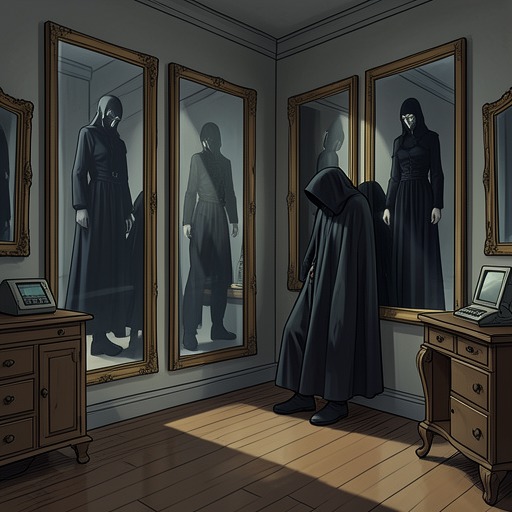
The earlier mirror incident intensifies this instability. A shadow holds Y/N’s wrist and pulls her through a mirror whose surface feels like water, leaving her inside the mirror. Mark’s later conduct belongs to the same broader system of thresholds, concealed agents, and disrupted control. The story repeatedly makes the body and the passage through space vulnerable to forces that do not announce themselves clearly. Mark embodies that danger in interpersonal form: his soft touch, smile, and courteous introduction conceal an intention to remove Y/N from her chosen companions.
Narrative Function and Contrast
Mark’s narrative function is that of a threshold antagonist and controlled deceiver. He appears precisely when Y/N has gained a small victory by recognizing an illusion, so the scene refuses to let discernment produce immediate safety. Instead, success attracts attention. His applause transforms the test into surveillance: someone has been present, watching, and waiting to reveal himself only after Y/N proves capable of resisting false appearances.
His contrast with Suga is equally decisive. Mark approaches Y/N, touches her, names his desire, and assumes possession; Suga intervenes physically and verbally, pushing him away and refusing to surrender her. The conflict thus dramatizes two incompatible models of protection and authority. Mark’s authority depends on entitlement and enforced movement, whereas Suga’s resistance attempts to preserve Y/N’s agency even within a world where vampires, green-eyed entities, mirrors, and supernatural powers repeatedly threaten to take control of bodies.
Mark’s later appearance near the giant stone tower confirms that his first encounter is not an isolated provocation. He remains attached to the process of drawing Y/N deeper into the green-eyed faction’s territory and objectives. Even when the narrative’s final movement turns toward Y/N’s active use of power—pushing Gehan away and imagining the gates of hell into existence—Mark’s earlier role helps define what has changed. The girl once treated as someone to be abandoned, captured, or handed over becomes capable of resisting the forces that sought to move her. Mark’s importance lies in making that struggle visible: beneath the courteous surface, he is an agent of dispossession, and his presence turns the question of identity into a fight over who may decide where Y/N belongs and what happens to her body.